
Lester Li
Lester Li
Marketing Manager
Marketing Manager
The WeChat Playbook: What Actually Works for B2B Brands in China
The WeChat Playbook: What Actually Works for B2B Brands in China
The WeChat Playbook: What Actually Works for B2B Brands in China
WeChat marketing for B2B companies in China works best when it is built around trust, technical expertise, and direct communication.
This is especially true for companies in industrial equipment, agri-tech, life sciences, and professional services. These buyers are not looking for entertainment, viral campaigns, or generic company news. They are looking for credible answers to specific business and technical problems.
That is why the WeChat strategy for B2B looks very different from the strategy for consumer brands.
Key Takeaways
WeChat works best as a trust layer, not just a publishing channel. For B2B brands in China, it often acts as the place where prospects check whether you are active, credible, and worth speaking to.
Evidence beats branding language. Case studies, practical guides, product explanations, and technical proof tend to outperform generic promotional copy.
A verified Official Account matters. It is often more persuasive than a translated corporate website because it signals commitment to the Chinese market.
Mini-Program and WeCom support conversion. WeChat becomes far more useful when it is connected to lead capture, CRM follow-up, and sales routing.
Consistency matters more than volume. A smaller, relevant audience that engages regularly is more valuable than chasing broad reach with weak content.
WeChat should support the wider China funnel. It works best alongside events, PR, search, and partner activity, then converts that interest into conversations.
What Works on WeChat for B2B: Why Technical and Educational Content Performs Best
The most effective WeChat content for industrial and B2B brands is not promotional. It is educational.
Chinese procurement managers, engineers, distributors, and technical buyers want to understand how a product, system, or service solves a real problem in the Chinese market.
Strong WeChat content usually answers questions such as:
How does this technology perform under Chinese operating conditions?
What certifications or compliance issues matter?
How does the European solution compare with local alternatives?
What implementation risks should a buyer consider?
What after-sales or service model is available in China?
This type of content does three things at once. It demonstrates expertise, addresses a real buyer concern, and positions the company as a serious partner rather than just another foreign vendor.
What Does Not Work on WeChat: Why Product Announcements Fail With Chinese B2B Buyers
Many companies use WeChat to post press releases, product updates, award announcements, or translated news from their European website.
This rarely performs well.
Chinese B2B buyers do not usually follow an Official Account because they want company news. They follow because the content helps them understand a technical topic, evaluate a supplier, or solve a business problem.
A useful rule is this:
If the article is mainly about the company, it is probably too weak. If it is mainly about the buyer’s problem, it has a better chance of performing.
How to Use Trade Shows as a WeChat Growth Channel for B2B in China
For B2B companies, trade shows remain one of the most effective ways to build a qualified WeChat audience.
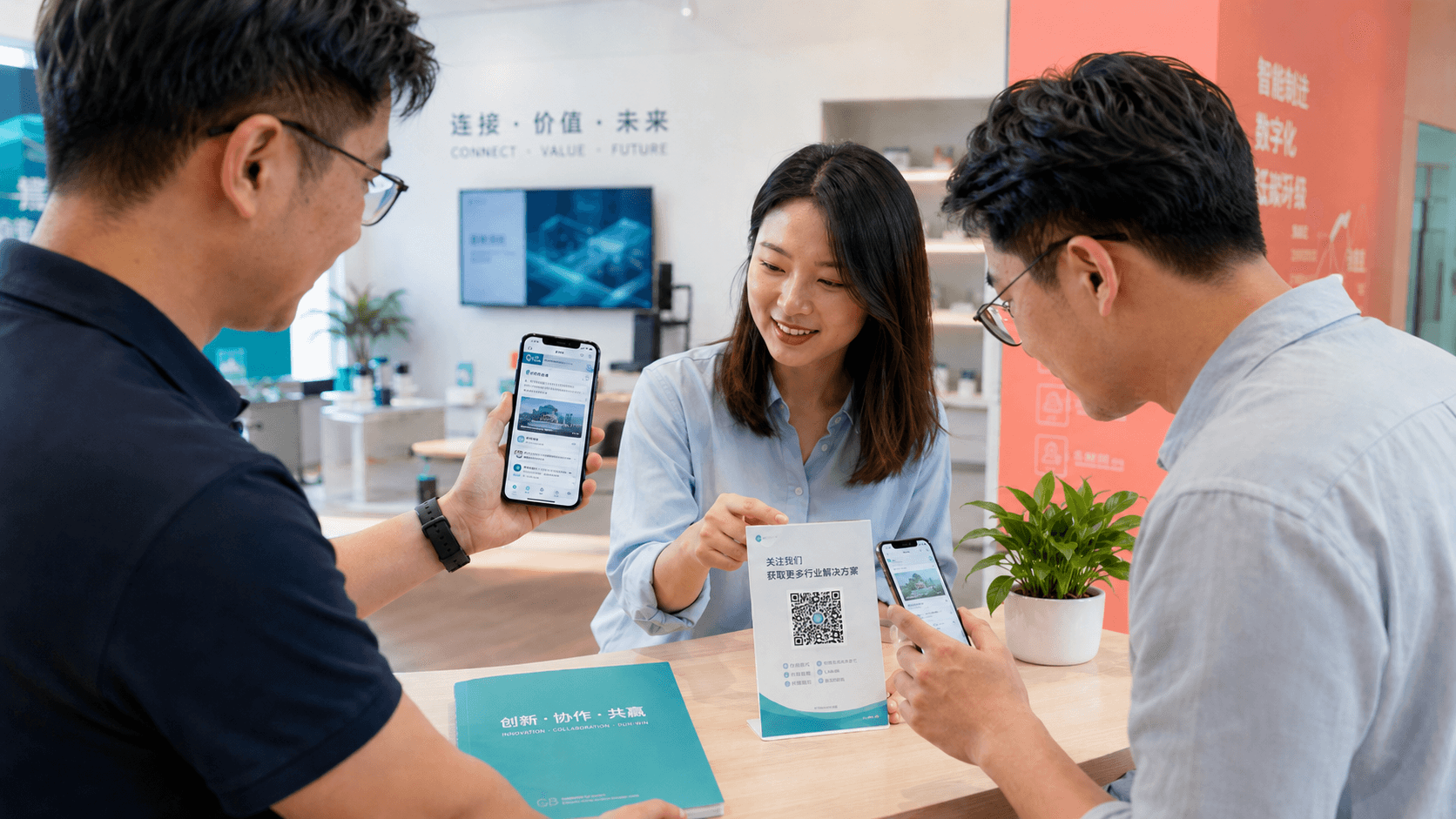
A QR code at a booth can turn a short conversation into an ongoing relationship. This matters because many China sales cycles are long. A buyer may not be ready to purchase immediately, but once they follow the WeChat account, the company can continue educating and nurturing them.
The most effective trade show approach usually includes:
A visible WeChat QR code at the booth
A reason to follow, such as technical content or a downloadable guide
A post-event WeChat article summarizing key market themes
WeCom follow-up from the sales or China team
Segmentation of leads by sector, product interest, or buyer role
This turns the event from a one-time interaction into a structured follow-up channel.
Why WeCom Should Be Part of Your China B2B Setup From Day One
WeCom, formerly known as WeChat Work, is where many B2B conversations in China actually happen.
A WeChat Official Account is the public-facing content channel. WeCom is the private relationship management tool.
Chinese buyers often expect faster and more informal communication than European teams are used to. Email can feel slow. Phone calls can feel too formal. WeCom allows direct communication, group chats, file sharing, and CRM-style contact management inside the WeChat ecosystem.
For foreign companies, this is particularly important because of time zones. If a Chinese buyer sends a message during the Chinese working day and receives a reply eight hours later, the delay can slow momentum or signal low commitment.
A China-side team member or agency partner should usually manage WeCom responses during local business hours.
How WeChat Mini Programs Helps B2B Companies Convert Warm Traffic Into Enquiries
WeChat Mini Programs are lightweight apps inside WeChat. For B2B brands, they are most useful once the company already has a growing follower base and regular buyer engagement.
Useful Mini Program formats include:
Product catalogues with inquiry forms
Technical specification libraries
Event registration tools
Demo booking forms
Gated whitepaper downloads
Distributor or partner portals
The important point is timing. A Mini Program is most valuable when there is already warm traffic inside WeChat. Building one too early can create another underused asset.
For many industrial companies, the right time to consider a Mini Program is when the account has a meaningful base of qualified followers and the sales team needs a better way to convert interest into inquiries.
How Often Should You Publish on WeChat - and What to Post
For most industrial and professional services brands, two strong Mandarin articles per month is a more realistic and effective starting point than weekly low-quality posts.
Quality matters more than frequency. A single well-researched technical article can outperform several short updates if it is relevant to the buyer’s needs.
A strong monthly content mix might include:
One technical problem-solving article
One market or regulatory insight
One event follow-up or case-style article
One product application article, written from the buyer’s perspective
Frequently Asked Questions: WeChat for B2B Brands in China
Is WeChat still important for B2B brands in China?
Yes. WeChat is still one of the most important owned channels for B2B brands in China because it combines content, credibility, and direct contact in one place. It is often where buyers validate whether a company is active, relevant, and set up to work locally.
What type of WeChat content works best for B2B?
The strongest content is practical and proof-led. Case studies, technical explainers, industry insights, and content that helps buyers do their jobs tend to perform better than brand-led posts or vague promotional updates.
Should foreign B2B brands use a Subscription Account or Service Account?
It depends on the publishing model, but the account should be chosen based on how the brand plans to use WeChat commercially. If the goal is credibility, education, and regular follow-up, the setup should support that clearly rather than just exist as a placeholder.
Do B2B brands need a Mini-Program on WeChat?
Not always at the start. A Mini-Program becomes useful when the brand needs stronger lead capture, product exploration, event registration, or gated content. For simpler market entry, a verified Official Account and clear conversion path may be enough.
How often should a B2B brand post on WeChat?
Consistency matters more than chasing high volume. It is better to publish useful content regularly and maintain quality than to post frequently without a clear point of view or commercial relevance.
What is the main role of WeChat in the B2B funnel?
Its main role is to turn awareness into trust and trust into conversation. WeChat usually works best after interest already exists, helping prospects move from curiosity to a qualified sales discussion.
The Bottom Line: How to Combine Content, WeCom and Mini Programs Into a China Sales System
For industrial companies, WeChat should not be used as a broadcast channel. It should be used as a trust-building and conversion system.
The companies that perform best usually combine:
Localized Mandarin technical content
Baidu and Zhihu traffic
Trade show QR code acquisition
WeCom sales follow-up
Mini Programs for lead capture
Consistent reporting on buyer engagement
This is where WeChat becomes valuable. Not as a standalone marketing channel, but as the platform that keeps Chinese buyers connected once they have discovered the brand elsewhere.
For B2B companies entering China, the goal is not to “post on WeChat.” The goal is to use WeChat to turn awareness into conversations, and conversations into qualified pipeline.
WeChat marketing for B2B companies in China works best when it is built around trust, technical expertise, and direct communication.
This is especially true for companies in industrial equipment, agri-tech, life sciences, and professional services. These buyers are not looking for entertainment, viral campaigns, or generic company news. They are looking for credible answers to specific business and technical problems.
That is why the WeChat strategy for B2B looks very different from the strategy for consumer brands.
Key Takeaways
WeChat works best as a trust layer, not just a publishing channel. For B2B brands in China, it often acts as the place where prospects check whether you are active, credible, and worth speaking to.
Evidence beats branding language. Case studies, practical guides, product explanations, and technical proof tend to outperform generic promotional copy.
A verified Official Account matters. It is often more persuasive than a translated corporate website because it signals commitment to the Chinese market.
Mini-Program and WeCom support conversion. WeChat becomes far more useful when it is connected to lead capture, CRM follow-up, and sales routing.
Consistency matters more than volume. A smaller, relevant audience that engages regularly is more valuable than chasing broad reach with weak content.
WeChat should support the wider China funnel. It works best alongside events, PR, search, and partner activity, then converts that interest into conversations.
What Works on WeChat for B2B: Why Technical and Educational Content Performs Best
The most effective WeChat content for industrial and B2B brands is not promotional. It is educational.
Chinese procurement managers, engineers, distributors, and technical buyers want to understand how a product, system, or service solves a real problem in the Chinese market.
Strong WeChat content usually answers questions such as:
How does this technology perform under Chinese operating conditions?
What certifications or compliance issues matter?
How does the European solution compare with local alternatives?
What implementation risks should a buyer consider?
What after-sales or service model is available in China?
This type of content does three things at once. It demonstrates expertise, addresses a real buyer concern, and positions the company as a serious partner rather than just another foreign vendor.
What Does Not Work on WeChat: Why Product Announcements Fail With Chinese B2B Buyers
Many companies use WeChat to post press releases, product updates, award announcements, or translated news from their European website.
This rarely performs well.
Chinese B2B buyers do not usually follow an Official Account because they want company news. They follow because the content helps them understand a technical topic, evaluate a supplier, or solve a business problem.
A useful rule is this:
If the article is mainly about the company, it is probably too weak. If it is mainly about the buyer’s problem, it has a better chance of performing.
How to Use Trade Shows as a WeChat Growth Channel for B2B in China
For B2B companies, trade shows remain one of the most effective ways to build a qualified WeChat audience.
A QR code at a booth can turn a short conversation into an ongoing relationship. This matters because many China sales cycles are long. A buyer may not be ready to purchase immediately, but once they follow the WeChat account, the company can continue educating and nurturing them.
The most effective trade show approach usually includes:
A visible WeChat QR code at the booth
A reason to follow, such as technical content or a downloadable guide
A post-event WeChat article summarizing key market themes
WeCom follow-up from the sales or China team
Segmentation of leads by sector, product interest, or buyer role
This turns the event from a one-time interaction into a structured follow-up channel.
Why WeCom Should Be Part of Your China B2B Setup From Day One
WeCom, formerly known as WeChat Work, is where many B2B conversations in China actually happen.
A WeChat Official Account is the public-facing content channel. WeCom is the private relationship management tool.
Chinese buyers often expect faster and more informal communication than European teams are used to. Email can feel slow. Phone calls can feel too formal. WeCom allows direct communication, group chats, file sharing, and CRM-style contact management inside the WeChat ecosystem.
For foreign companies, this is particularly important because of time zones. If a Chinese buyer sends a message during the Chinese working day and receives a reply eight hours later, the delay can slow momentum or signal low commitment.
A China-side team member or agency partner should usually manage WeCom responses during local business hours.
How WeChat Mini Programs Helps B2B Companies Convert Warm Traffic Into Enquiries
WeChat Mini Programs are lightweight apps inside WeChat. For B2B brands, they are most useful once the company already has a growing follower base and regular buyer engagement.
Useful Mini Program formats include:
Product catalogues with inquiry forms
Technical specification libraries
Event registration tools
Demo booking forms
Gated whitepaper downloads
Distributor or partner portals
The important point is timing. A Mini Program is most valuable when there is already warm traffic inside WeChat. Building one too early can create another underused asset.
For many industrial companies, the right time to consider a Mini Program is when the account has a meaningful base of qualified followers and the sales team needs a better way to convert interest into inquiries.
How Often Should You Publish on WeChat - and What to Post
For most industrial and professional services brands, two strong Mandarin articles per month is a more realistic and effective starting point than weekly low-quality posts.
Quality matters more than frequency. A single well-researched technical article can outperform several short updates if it is relevant to the buyer’s needs.
A strong monthly content mix might include:
One technical problem-solving article
One market or regulatory insight
One event follow-up or case-style article
One product application article, written from the buyer’s perspective
Frequently Asked Questions: WeChat for B2B Brands in China
Is WeChat still important for B2B brands in China?
Yes. WeChat is still one of the most important owned channels for B2B brands in China because it combines content, credibility, and direct contact in one place. It is often where buyers validate whether a company is active, relevant, and set up to work locally.
What type of WeChat content works best for B2B?
The strongest content is practical and proof-led. Case studies, technical explainers, industry insights, and content that helps buyers do their jobs tend to perform better than brand-led posts or vague promotional updates.
Should foreign B2B brands use a Subscription Account or Service Account?
It depends on the publishing model, but the account should be chosen based on how the brand plans to use WeChat commercially. If the goal is credibility, education, and regular follow-up, the setup should support that clearly rather than just exist as a placeholder.
Do B2B brands need a Mini-Program on WeChat?
Not always at the start. A Mini-Program becomes useful when the brand needs stronger lead capture, product exploration, event registration, or gated content. For simpler market entry, a verified Official Account and clear conversion path may be enough.
How often should a B2B brand post on WeChat?
Consistency matters more than chasing high volume. It is better to publish useful content regularly and maintain quality than to post frequently without a clear point of view or commercial relevance.
What is the main role of WeChat in the B2B funnel?
Its main role is to turn awareness into trust and trust into conversation. WeChat usually works best after interest already exists, helping prospects move from curiosity to a qualified sales discussion.
The Bottom Line: How to Combine Content, WeCom and Mini Programs Into a China Sales System
For industrial companies, WeChat should not be used as a broadcast channel. It should be used as a trust-building and conversion system.
The companies that perform best usually combine:
Localized Mandarin technical content
Baidu and Zhihu traffic
Trade show QR code acquisition
WeCom sales follow-up
Mini Programs for lead capture
Consistent reporting on buyer engagement
This is where WeChat becomes valuable. Not as a standalone marketing channel, but as the platform that keeps Chinese buyers connected once they have discovered the brand elsewhere.
For B2B companies entering China, the goal is not to “post on WeChat.” The goal is to use WeChat to turn awareness into conversations, and conversations into qualified pipeline.